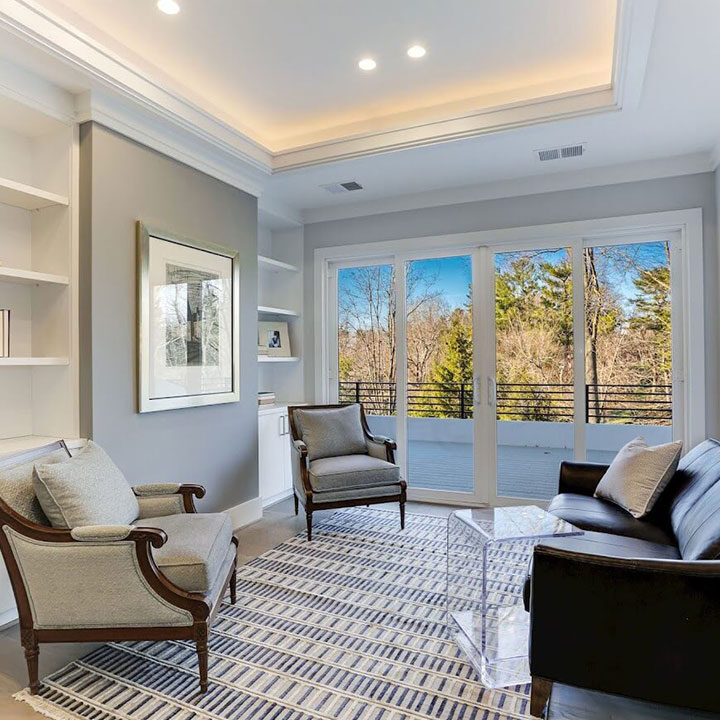
There's a reason lift and slide doors have become the signature feature of luxury custom homes in the GTA over the past decade. They do something architecturally that no other product can: eliminate the visual boundary between interior living space and the outdoors, without compromising the building envelope.
But they're also the most technically demanding door system we install — and the one with the most questions from homeowners at the specification stage. Here's what you need to know.
What Makes Lift & Slide Different From a Regular Sliding Door
In a standard sliding door, the panel sits in a fixed track and slides by rolling along the bottom. The seal depends entirely on the weatherstripping making contact — which is why standard sliding doors are notoriously draughty, especially in cold weather.
In a lift-and-slide system, operating the handle lifts the panel slightly off its bottom seal and onto precision stainless steel rollers. The panel then glides with almost no effort regardless of its weight. When the handle is returned to the locked position, the panel drops back down onto a full perimeter compression seal — the same principle as a swing door. The airtightness is in a completely different class.
This mechanism also allows panels to be dramatically larger and heavier than standard sliding doors — which is what enables the floor-to-ceiling glass walls that define these systems.
What You Can Actually Build
The systems we supply from Alumil can accommodate single panels up to 6 metres wide and up to the full ceiling height of most residential construction. Multi-panel configurations can stack all panels to one side to create a fully open wall, or arrange as a combination of fixed and operable panels depending on the layout.
Sightlines between adjacent glass panels can be as narrow as 20mm — creating an almost frameless appearance that maximizes the glass area and the view through.
Structural Requirements
This is where many projects get into difficulty. A large lift-and-slide door requires:
- A structural header above the opening capable of spanning the full width without deflection
- A perfectly level and flat floor at the threshold (within 2mm over the full width)
- A rough opening dimensioned precisely to the frame specification — not approximated
- Structural provisions for the door weight in the floor slab or subfloor
These requirements should be part of the structural design from the beginning of the project — not addressed as an afterthought after framing is complete.
Important: We always recommend involving us at the design stage for lift-and-slide projects. The structural rough opening requirements and the frame specification must be coordinated before framing begins. Changes after the fact are expensive.
Performance in a Canadian Winter
A common concern is how a large glass door performs thermally. The answer is that a properly specified lift-and-slide system — thermally broken aluminum profiles, triple-glazed units, perimeter compression seal — performs comparably to a high-quality swing door in terms of air infiltration and conductance.
The honest caveat: the large glass area of a floor-to-ceiling system means total heat loss through the assembly is greater than a standard door with the same U-value per unit area, simply because there's more of it. That's the trade-off you make for the view and the opening capability — and for most projects in Toronto's climate, it's a trade-off that works well.
What to Budget
Lift-and-slide systems are a premium product with premium pricing. A single large panel in a standard two-panel configuration for a typical residential application starts significantly higher than a standard patio door. Larger configurations, multiple panels, and premium hardware all add cost. We provide detailed quotes after assessing the specific opening and configuration.
Specifying a lift & slide door for your project?
Book a consultation early — structural coordination is critical and best done before framing begins.