Your front door does more work than any other element of your home's exterior. It's the first impression for every visitor, the primary security barrier, and a significant component of your building envelope. Getting it right matters — and the material choice is more consequential than most homeowners realize.
The Three Main Materials
Aluminum Entry Doors
Aluminum entry doors from European profile systems offer the slimmest, most contemporary aesthetic — identical sightlines to the aluminum windows they're paired with, powder-coated in any RAL colour. The structural rigidity of aluminum makes it excellent for large doors, double doors, and doors with large glass panels.
Thermally broken aluminum entry doors perform well in Canadian winters, though a well-insulated fiberglass door will typically have a better total R-value through the panel itself. The choice between aluminum and fiberglass for an entry door is largely about whether the contemporary metal aesthetic is the priority, or whether maximum thermal performance through a solid insulated panel is.
Fiberglass Entry Doors
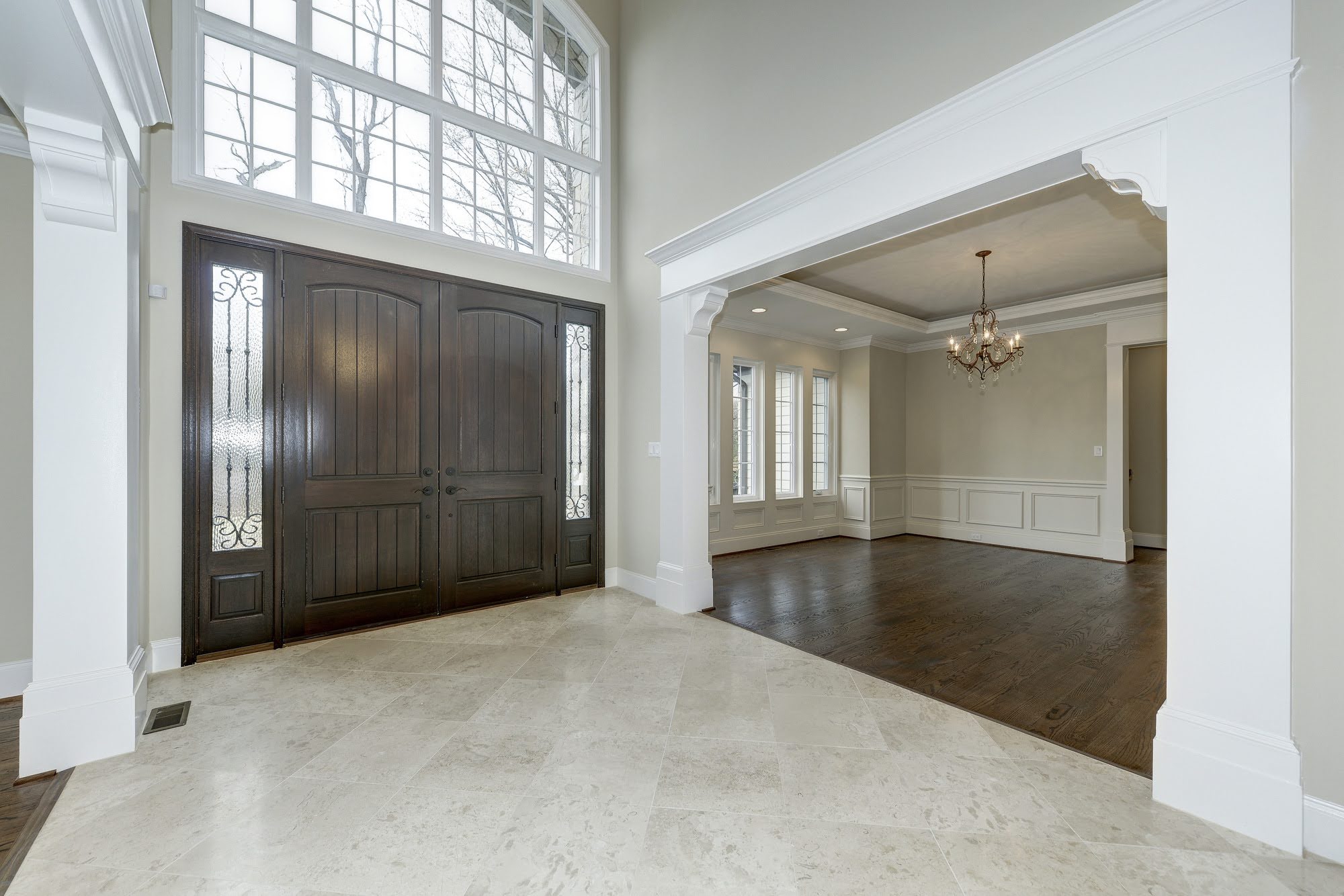
Fiberglass has become the default premium entry door material for homeowners who want the look of real wood without the maintenance requirements. Quality fiberglass doors are compression-moulded with deep, realistic woodgrain textures that can be factory-stained in a wide range of finishes — oak, mahogany, walnut, and others.
The performance advantages are significant: fiberglass doesn't warp, swell, crack, or require refinishing. A quality fiberglass door installed correctly will look essentially unchanged after 25 years of Toronto winters. The insulated core provides excellent thermal performance — the panel itself is more insulating than an equivalent aluminum panel.
The aesthetic limitation of fiberglass is that it doesn't match aluminum window profiles as seamlessly as an aluminum door does. If your windows are European aluminum with slim profiles, an aluminum entry door makes the facade read as a more cohesive design.
Steel Entry Doors
Steel doors offer the highest security ratings among the three materials — important for homeowners for whom forced entry resistance is the primary concern. Quality steel doors with multi-point locking systems are significantly more resistant to kick-in and impact attacks than fiberglass or aluminum.
The trade-offs: steel can dent, and some steel doors conduct cold through the frame if they're not thermally broken. For most Toronto residential applications where security is one consideration among several, fiberglass or aluminum will serve better. For applications where security is the dominant concern — a rear or garage entrance, for example — steel is worth considering.
What Actually Matters for Performance in Toronto
The frame, not just the door
Heat loss and air infiltration in an entry door assembly primarily occur at the frame-to-wall interface and through the weatherstripping, not through the door panel itself. A premium door in a poorly installed frame with inadequate air sealing will underperform a mid-range door that's been installed correctly. Ask your contractor specifically about the rough opening preparation and air sealing method.
Multi-point locking
All entry doors we supply use European multi-point locking systems that engage at three to five points along the door edge simultaneously. This dramatically improves both security and the compression of the perimeter weatherstripping — the door is pulled tightly against its seal at multiple points, not just at the latch.
Threshold design
The bottom seal is the most difficult part of an entry door to get right in a Canadian climate — you need an effective air and water seal while also having a threshold that doesn't become a trip hazard or trap ice and water. We use adjustable compression threshold systems that can be set correctly during installation and adjusted if the building settles.
Choosing a new entry door for your Toronto home?
We'll show you samples of all three material options and help you find the right fit for your facade and priorities.
Sidelites and Transoms
An entry door doesn't have to stand alone. Sidelites (fixed glass panels on one or both sides of the door) and transoms (a glass panel above the door) can dramatically change the architectural presence of an entrance — bringing in light, creating a larger compositional frame, and making a narrow door look proportionally appropriate in a wider facade opening.
We fabricate these as complete assemblies — door, sidelites, transom, and surrounding frame as a single engineered unit, not pieces from different sources assembled on site. The result is a consistent appearance and a more reliable seal.